

Is It Too Late To Register Your Japanese Child In The Koseki
Japan's koseki family unit registry system and anachronistic laws governing familial relations have produced the problem of mukosekisha—unregistered citizens unable to take office in society and practice their bones rights. The author makes the case for fundamental reform, arguing that Japan's system is out of pace with global norms and its ain Constitution.
There are times in life when a person needs to submit fundamental documentary proof of his or her identity, birthdate, citizenship, and parentage—for example, for purposes of securing a passport or a marriage license or claiming an inheritance. In the Due west, each individual is issued a certificate of birth that can exist used for such purposes. In Nippon, this office is assigned to the family unit registry, or koseki. Those who through no fault of their ain observe themselves with no koseki registration are in essence denied their rights as Japanese citizens. In the following, I examine this social issue and its roots in Japan's outdated Ceremonious Code.
Japan's Primitive Family Registry System
Under the koseki organization, local governments are required to maintain registries for each Japanese household in their jurisdiction, and each such household is required to report births, deaths, marriages, and other changes in family composition.
Koseki registration is express to Japanese citizens. (Marriages to non-Japanese spouses are recorded as marginal notations merely non officially registered.) This means that anyone with such a registration can easily prove that he or she is of Japanese parentage and therefore entitled to all the rights of a Japanese denizen. Koseki registration is non, strictly speaking, a requirement for citizenship; anyone born in Japan to either a Japanese mother or a Japanese father may claim Japanese nationality. That said, establishing proof of parentage tin be exceedingly difficult if ane is not registered on a parent'due south koseki.
The upshot is that in Japan, without proof of koseki registration (either an official copy of the certificate or an official extract)—one cannot obtain a passport and so as to travel abroad, be legally married, or merits one's legal rights as an heir. In essence, one is deprived of 1's rights as a denizen.
The unit of registration in this system is not the individual merely the nuclear family, with each family registered under a unmarried surname. Under Japanese constabulary, the married man and married woman must take the same surname, and in 96% of cases, they take the married man'due south. Thus, in actual practise, the koseki is the married man'due south, with the wife and children added on as household members. This system perpetuates a narrow and outdated concept of the family, and it has contributed greatly to the problem of non-registration.
Nascence of a Social Issue
The problem of the mukosekisha received little attention until a few years ago. In 2014, the unregistered began to intrude on the public consciousness cheers to a series of stories in the news media, particularly the daily Asahi Shimbun and NHK (Japan Dissemination Corp.). At that time, unregistered persons were denied such social services as enrollment in National Wellness Insurance, forth with the right to obtain a commuter'southward license, a passport, and so forth.
In July 2014, the Ministry of Justice launched a survey to gauge the number and circumstances of unregistered persons in Japan. Such individuals are almost by definition difficult to identify, but as of October 10, 2017, the ministry building had tallied 1,495. (The actual number is believed to be many times that.) Subsequently, 780 of those identified were able to obtain registration, but the other 715 remained in limbo. Almost one-half of those (49.2%) were children under school age.
The Ministry of Justice and some local authorities have taken some steps to mitigate the isolation of these mukosekisha by making it possible for them to register with their municipality as residents, to receive national wellness insurance coverage, neonatal checkups, immunizations, and childcare subsidies, and to enroll in daycare and public school. However, given the circumstances that typically attend non-registration (run across beneath), nosotros can assume that the bulk remain unaware of their rights or unable to take advantage of them.
Falling Through the Cracks
How and why do people fall through the cracks of Nihon's family registration system?
When a child is built-in in Nippon, the parents are required to inform the municipal government through submission of a shussei todoke, notification of birth. The information in that document—including the child's gender and birthdate and basic information on the parents—is used to register the child on the family unit registry of the legal father (except in the rare instances in which the female parent holds the koseki).
In near situations, this registration proceeds without a hitch. In Japan, prenatal and neonatal care is advisedly monitored. Pregnant women are issued a wellness record book with a schedule for prenatal and neonatal examinations. The healthcare personnel responsible for delivering and examining the infant also assist the parents in registering their child. Even so, some parents conspicuously fail to do so.
In some instances, the problem tin be attributed to social isolation or neglect. A July 8, 2014, front-folio story in the Asahi Shimbun publicized the instance of a kid who was kept hidden at home, out of school, for 17 years.
In the majority of cases, nevertheless, the trouble relates to the koseki system and the Civil Lawmaking's outdated provisions regarding divorce and paternity. Co-ordinate to the Justice Ministry, 75.1% of the cases it has examined fall into this category.
The Problem of Presumed Paternity
Under Commodity 772, paragraph 1, of the Civil Code, a child conceived by a woman while she is married is presumed to be her married man's kid. This is known as the presumption of legitimacy. Because information technology tin can be difficult to evidence exactly when a kid was conceived, paragraph 2 states that any kid built-in within 300 days of a previous marriage's dissolution shall exist deemed to have been conceived during that marriage. Herein lies a big role of the problem.
Let u.s.a. consider two cases. In the showtime case, a woman leaves dwelling, fleeing her abusive husband. She becomes attached to a man more worthy of her angel, they become intimate, and she gives nativity to a child. Under Japanese police, if the child was conceived while she was nonetheless legally married to (albeit separated from) her husband, he is presumed to be the male parent. In the second case, a woman has been separated from her husband for some time, unable to secure a divorce. During the separation, she becomes intimate with another homo. Later on the divorce finally comes through, she remarries and has a child by her new hubby. If the child was born within 300 days (close to a twelvemonth) of the divorce, so the erstwhile husband is deemed to exist the begetter, even if information technology is articulate that the new husband is the biological parent.
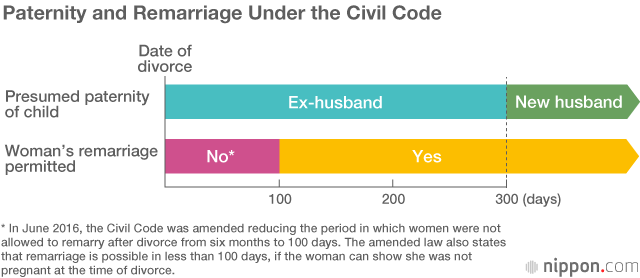
If the mother wishes to register the birth, she has no choice simply to tape the name of the legal father (the former or estranged husband) on the shussei todoke. If she enters the proper name of the biological father, the registration will be rejected. For a adult female who has divorced or separated from her husband—peculiarly in cases of domestic violence—this creates a major dilemma. Anyone tin can employ the public records to identify the child's legal begetter, and an calumniating husband or ex-hubby tin can apply them to rails downward his wife or one-time wife. In such instances, one tin can understand why a adult female would hesitate to register her child'southward birth.
In a total 50.9% of the cases reviewed by the Justice Ministry betwixt July 2014 and October 2017, the unregistered child was born within 300 days of the divorce. Some other 15.7% of the unregistered children were born during a spousal relationship that has since dissolved, while 11.2% were built-in during an ongoing matrimony..
One legal choice open to women in the cases described above is to petition the family unit court and inquire that it decide that no familial relationship exists betwixt the erstwhile (or estranged) husband and the child. If the family court confirms that no relationship exists, and so Article 772 is no longer applicable. However, to accomplish this the woman needs to prove that the couple were in a state of "de facto divorce" at the time the woman became pregnant. This can be extremely difficult if the former (or estranged) husband refuses to cooperate, or if the woman wants zippo more than to exercise with him.
The Ministry of Justice ruled in June 2007 that a divorced woman who gives birth within 300 days after her divorce tin submit a notification of nativity that does not name her former husband as the father as long as she attaches a letter from a physician certifying that the child was conceived later on the divorce became last. Nevertheless, this would not help women like those described above, who become pregnant while separated but not yet legally divorced from their spouses.
Republic of korea'southward Example
The Un Convention on the Rights of the Child (adopted in 1989), of which Japan is a signatory, states that "the child shall exist registered immediately after birth." This ways that the Japanese government has an obligation to reform a organization that gives rise to mukosekisha. To accomplish this and ensure prompt registration of each child built-in, Nihon needs to revise the Civil Code, with its outdated and discriminatory provisions surrounding divorce and paternity.
To comply with the Convention on the Rights of the Child, Nihon needs a organization that "respect[s] the correct of the child to preserve his or her identity, including . . . family relations" and guarantees the child a secure upbringing. In my view, the all-time way to reach this is to prefer the basic legal principle of designating the biological begetter as the legal father and to let the female parent to register the nascency of a child under the biological male parent's proper name without submitting to intrusive medical examinations or waiting for the courts to make a determination.
Nosotros tin begin by revising Commodity 772, paragraph 1, of the Civil Code to say that a child born while the mother is married is presumed to be the husband'due south kid. A child born after a woman has remarried would thus be deemed the kid of the electric current husband, thereby solving the dilemma of the woman in the outset case.
At the same fourth dimension, the constabulary should recognize the right of the mother or the adult child to deny the paternity of the presumed father, rather than assign that right to the husband only, as now (Articles 774 and 775). That would permit the woman in the second case to overturn the presumed paternity of her former husband by proving that he and the kid are not biologically related and to take her current hubby acknowledged as the legal father. Information technology is simply unreasonable to deny the female parent a say in the designation of her kid'southward begetter.
Japan's electric current organization is out of step with its own Constitution, which states that "in matters pertaining to marriage and the family, laws shall be enacted from the standpoint of individual nobility and the essential equality of the sexes." It is also out of sync with global trends. In other countries around the world, including Eastern asia, steps take been taken to reform antiquated family law. South korea, which had a system like to Nihon'southward, recognized the female parent's right to deny paternity in March 2005. In May 2007 it replaced the old family register with a personal registry system that records familial relationships on an individual basis. If South korea can modernize its Civil Lawmaking, so can Japan. The fundamental answer to the problem of the mukosekisha is for Japan to follow South Korea's example.
(Originally published in Japanese on February 8, 2018. Banner photo: An unregistered woman (centre foreground) at a press briefing in Osaka on June 2, 2008. Due to domestic violence her female parent did not annals her birth, and her own children were too unregistered. © Jiji.)
Source: https://www.nippon.com/en/currents/d00385/
Posted by: santiagostalich.blogspot.com
0 Response to "Is It Too Late To Register Your Japanese Child In The Koseki"
Post a Comment